Best 12 volt golf cart batteries: four for a 48V cart
Four 12-volt batteries make a 48V cart, and that is how the EZGO RXV and the early Club Car Precedent left the factory. These are the ones worth putting in, and the honest reason a four-battery set gives you a little less range than six 8-volts.
We pick from published specs, maker instructions and what owners report. We may earn a commission from links on this page; it never changes what we recommend. How we choose
Key takeaways
- Four 12V batteries make 48 volts, the factory layout of the EZGO RXV and the 2004 to 2008 Precedent.
- Buy the Trojan T-1275 if the budget allows and the Interstate GC12 if it does not.
- Four 12V give up about 12 percent of range against six 8V, roughly 24 miles against 28.
- Buy all four of one brand on the same day; a mixed set charges unevenly and dies early.
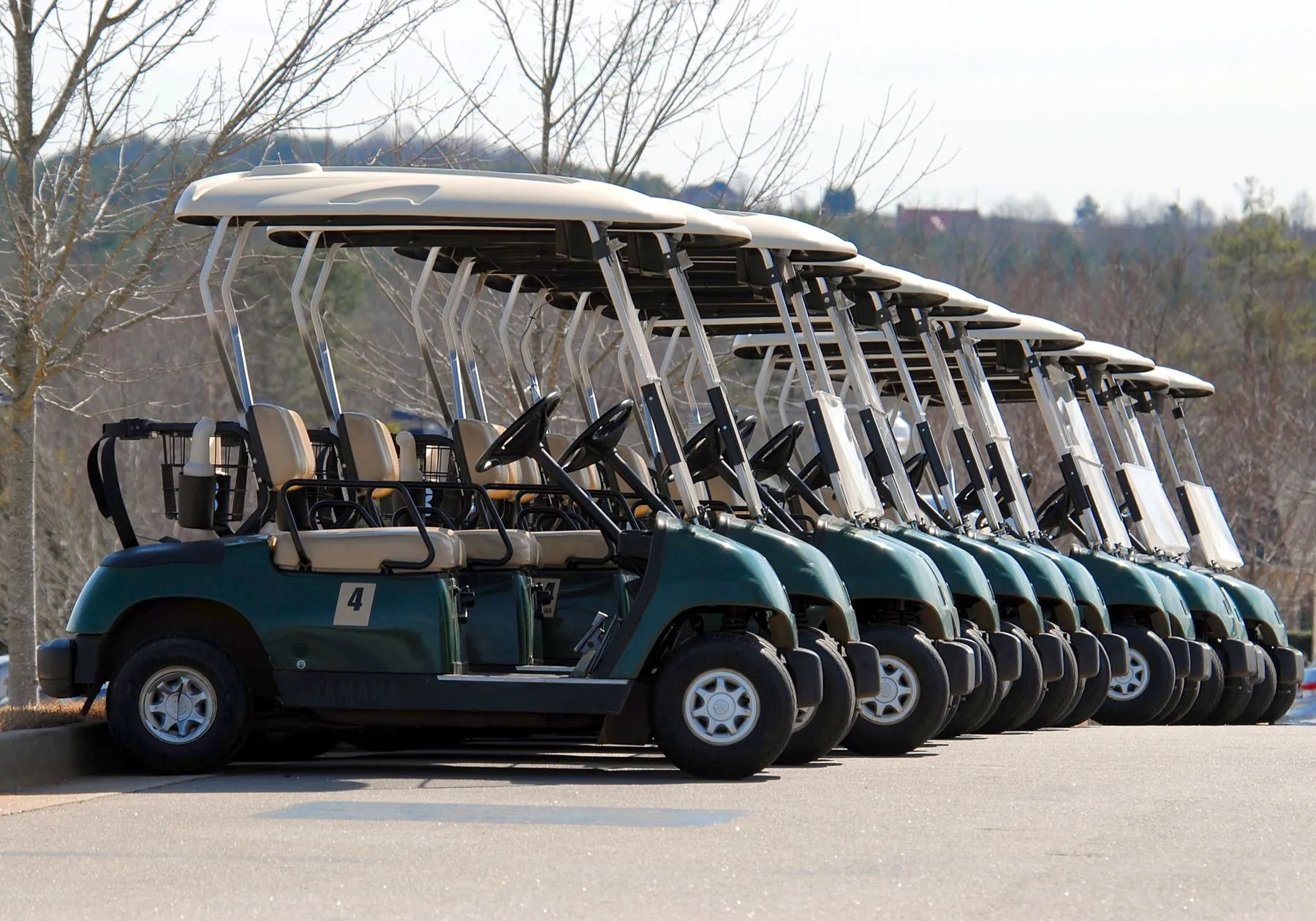
Our picks at a glance
Prices are estimates as of Oct 17, 2026
- 1Best overallTrojan T-1275Any 48V cart with four 12V slots: EZGO RXV, Club Car Precedent 2004 to mid-2008, 2007 to 2010 Yamaha Drive (G29), any cart with a GC12 trayabout$300–$390
- 2Best valueInterstate GC12 (East Penn / Deka built)Any four-slot 48V cart; same footprint as the T-1275about$230–$300
- 3Also worth a lookCrown CR-150Any four-slot 48V cartabout$260–$340
- 4For no watering12V AGM deep cycle, GC12 or group 31 caseAny four-slot 48V cart; group 31 is shorter and needs the hold-down adjustedabout$280–$450
- 5Lithium drop-inAllied Lithium 12V 105Ah, set of fourAny 48V cart with four 12V slots; sits in the stock tray with the stock hold-downsabout$2,400–$3,000
The picks in detail
1.Trojan T-1275
12V 150Ah at the 20-hour rate, GC12 case, about 82 lb
Fits: Any 48V cart with four 12V slots: EZGO RXV, Club Car Precedent 2004 to mid-2008, 2007 to 2010 Yamaha Drive (G29), any cart with a GC12 tray
At Amazon. We may earn a commission.
Pros
- Owners report five to seven years
- Thick plates built for daily deep cycling
Cons
- Priciest flooded 12V of the picks
- About 82 lb each, needs a strap and helper
Why we picked it
The T-1275 is the 12V battery dealers put in an RXV when the owner says buy the good ones. Thick plates, a dense paste and Trojan's long record of surviving daily deep cycling are why. Owners who water monthly and charge after every use report five to seven years from a set. It is the most expensive flooded 12V on this list by a little, and it is the one that most often earns it.
Before you buy: At 82 pounds each these are the heaviest batteries here; use a lifting strap and a second person.
2.Interstate GC12 (East Penn / Deka built)
12V about 150Ah, GC12 case, about 80 lb
Fits: Any four-slot 48V cart; same footprint as the T-1275
At Buggies Unlimited. We may earn a commission.
Pros
- Within a few amp-hours of the Trojan
- Same footprint as the T-1275 for less
Cons
- Tends to give out a season sooner
- Price varies a lot by region
Why we picked it
Interstate's golf cart batteries come out of the East Penn plant that also builds Deka and Duracell, so the GC12 is a serious battery at a lower price. Capacity on paper is within a few amp-hours of the Trojan. Where owners report a difference is in year five and six, when the Interstates tend to be done and the Trojans tend to have a season left. For a cart that goes a few miles a day, that gap rarely matters.
Before you buy: Interstate sells through dealers and Costco more than online; the price varies a lot by region.
3.Crown CR-150
12V 150Ah, GC12 case, about 82 lb
Fits: Any four-slot 48V cart
At Buggies Unlimited. We may earn a commission.
Pros
- Matches the T-1275 on capacity and case
- Usually a little under Trojan on price
Cons
- Fewer retailers carry it, so check the date code
Why we picked it
Crown is a US maker out of Ohio that competes directly with Trojan and usually comes in a little under on price. The CR-150 matches the T-1275 on capacity and case size and owners who run both report similar life. If a local dealer stocks Crown and not Trojan, buy the Crown and do not lose sleep.
Before you buy: Fewer retailers carry Crown, so check the date code on the post; a battery that sat on a shelf for a year is a worse deal at any price.
4.12V AGM deep cycle, GC12 or group 31 case
12V 100 to 150Ah sealed AGM depending on case size
Fits: Any four-slot 48V cart; group 31 is shorter and needs the hold-down adjusted
At Buggies Unlimited. We may earn a commission.
Pros
- No watering, no acid, no terminal crust
- Tolerates sitting half charged
Cons
- About 10 to 20 percent fewer amp-hours
- Needs a charger with an AGM profile
Why we picked it
AGM is still lead-acid but sealed, so there is no watering, no acid on the tray and no terminal crust. It also tolerates sitting half charged better than a flooded battery. You pay for it in capacity, since the AGM version of a case has about 10 to 20 percent fewer amp-hours, and in price. It is the right pick for a cart at a second home that gets used two weekends a month.
Before you buy: AGM needs a charger with an AGM profile; a flooded-profile charger will cook it over a summer.
5.Allied Lithium 12V 105Ah, set of four
Four 12V 105Ah LiFePO4, 48V in series, 10-year warranty
Fits: Any 48V cart with four 12V slots; sits in the stock tray with the stock hold-downs
At Amazon. We may earn a commission.
Pros
- Drops into the stock tray and hold-downs
- About 28 pounds each instead of 82
- No water, no equalizing, 10-year warranty
Cons
- Highest price of the picks here
- May need a new lithium charger
Why we picked it
If your tray already holds four 12V batteries, this is the easiest lithium conversion there is. The four Allied batteries are the size of a car battery, wire in series exactly like the lead-acid they replace, and weigh about 28 pounds each instead of 82. Usable energy is about the same as a flooded set because you can run lithium nearly flat. No water, no equalizing, no sulfation in storage.
Before you buy: Four batteries means four BMS units. Charge to full after the first few rides so they balance, and buy the lithium charger if yours has no lithium profile.
If your cart has four batteries under the seat and runs at 48 volts, you need 12 volt golf cart batteries, and the Trojan T-1275 is the one to buy if the budget allows. The Interstate GC12 is the one to buy if it does not. Either way, buy four of the same brand on the same day; a mixed set charges unevenly and dies early.
The golf cart batteries hub covers the rest of the category. If you are not sure which voltage or how many slots you have, the 48 volt battery page walks through the six-8V, four-12V and eight-6V layouts, and the battery calculator will tell you whether a flooded set or lithium is the cheaper ten-year answer for the way you drive.
Which carts use four 12V batteries
The EZGO RXV, from 2008 on, left the factory with four 12V batteries, usually Trojan T-1275s or an equivalent. That is the main reason the GC12 case exists in golf cart sizes at all. The Club Car Precedent ran four 12V from its 2004 launch until the i2 battery bucket arrived in mid-2008, and the 2007 to 2010 Yamaha Drive (G29) also came with four 12V as standard; Yamaha offered a six-8V tray as an option from about 2008 and fitted a floor pan that takes either layout from the 2011 model year. EZGO sells a six-battery tray for the RXV, so an RXV you are looking at may have been converted; count before you order.
Everything else at 48V came with six 8V: the Club Car DS from 1995, the Precedent from mid-2008, the Onward and Tempo, the EZGO TXT48 from 2010, and the Yamaha G19, G22, 2011 and later Drive and Drive2. Yamaha also offers eight 6V as a long-range option on the Drive and Drive2. Those trays will also hold four 12V if you move the hold-downs, which is the budget route some owners take. The fitment finder confirms your layout from make and year.
Why four 12V gives you less range than six 8V
Every golf cart battery in the GC family sits in a case about 10 by 7 inches and 11 to 12 inches tall. A 6V battery fills that case with three cells. An 8V fills it with four. A 12V fills it with six. Same lead, same box, more partitions, so each cell in a 12V gets less plate area, and plate area is capacity.
Put numbers on it. The T-1275 is rated 150Ah at the 20-hour rate. Four of them at 48V is 7.2 kWh. Six T-875 8-volts at 170Ah is 8.2 kWh. Eight T-105 6-volts at 225Ah is 10.8 kWh. A four-12V cart gives up about 12 percent against six 8V and a third against eight 6V. On a four-seater that is roughly 24 miles against 28 against 36.
The trade is weight and money. Four 12V batteries weigh about 330 pounds against 380 for six 8V and nearly 500 for eight 6V, and a set of four costs a few hundred less than a set of six.
Flooded, AGM or lithium
Flooded is the default and the cheapest per amp-hour. It needs distilled water about once a month, the terminals need cleaning a couple of times a year, and it will sulfate if you leave it half charged. For a cart that is driven and charged most days, flooded is still the best value. The maintenance page covers the routine.
AGM costs about a third more, holds a little less, and asks nothing of you. It makes the most sense where the cart sits for weeks between uses, or where the owner is not going to lift the seat with a jug of water every month.
Lithium costs about twice a flooded set up front: about $2,400 to $3,000 for four Allied 12V batteries against about $1,200 to $1,560 for four T-1275s, and a little more than that against an Interstate set. In a four-slot cart it is a clean swap because Allied and a few others sell 12V lithium batteries in a car-battery case that drop in and wire in series like the old ones. The lithium guide covers what changes; the short version is 50 pounds less per battery, no water, and the same range from fewer amp-hours because you can use nearly all of them.
Reading the spec sheet
Amp-hours at the 20-hour rate is the number to compare; some sellers quote the 100-hour rate, which reads 10 to 15 percent higher for the same battery. Reserve capacity in minutes is a car battery figure and tells you little here.
Look for the date code stamped or stickered on the case or the post. A flooded battery loses charge on the shelf, and one that is more than six months old when you buy it has already lost some life. Trojan uses a letter for the month and a digit for the year.
Terminals on golf cart batteries are 5/16-inch stud posts or a combined post that takes a 5/16 bolt. The battery cables page has lug sizes and gauge if you are replacing cables at the same time, which you should if the old ones are green.
Which one for your cart
| Cart | Stock layout | 12V pick | Note |
|---|---|---|---|
| EZGO RXV 2008 and later | Four 12V | Trojan T-1275 or Interstate GC12 | The tray is sized for GC12; group 31 AGM needs the hold-down shimmed |
| EZGO TXT48 2010 and later | Six 8V | Four T-1275 only as a budget swap | Loses about 12 percent range against the stock six 8V |
| Club Car Precedent, Onward, Tempo | Six 8V (some fleets four 12V) | T-1275 if the tray has four slots | Check for the four-battery tray before ordering |
| Club Car DS 1995 and later | Six 8V | Four 12V as a budget swap | Stock cables may be short for the four-battery layout |
| Yamaha Drive, Drive2, G19, G22 | Eight 6V | Not recommended | Eight 6V gives far more capacity in the same tray; stay with 6V |
Fitment pages for Club Car, EZGO and Yamaha have the serial plate locations if you need to confirm the year.
Install: about an hour
Photograph the old wiring before you touch anything. Set a Club Car or RXV to Tow before you disconnect. Remove the main negative first, then the main positive, then the jumpers. Lift each battery out with a strap; 82 pounds held by the posts is how posts break.
Clean the tray with baking soda and water, rinse, dry, and set the new batteries in the same orientation as the old. Wire in series: positive of battery one to the main positive cable, negative of one to positive of two, and so on, with the negative of battery four to the main negative. The 48 volt diagram page has this as a table by cart. Tighten the terminal bolts to about 8 foot-pounds, which is Trojan’s spec, coat them, and charge to full before the first drive.
Questions owners ask
Can I use four 12V batteries in a cart that came with six 8V?
Yes, and plenty of owners do it to save a couple hundred dollars. Four 12V in series is still 48V, you leave two slots empty and move the hold-downs. You give up about 12 percent of capacity, so a cart that went 28 miles on six 8-volts goes about 24 on four 12-volts. The wiring is on the 48V diagram page.
Why do 12 volt golf cart batteries have less capacity than 8 volt or 6 volt?
Each case is about the same size, but a 12V battery has six cells inside it, an 8V has four and a 6V has three. More cells in the same box means less lead per cell, and lead is capacity. Four 12V at 150Ah is 7.2 kWh; six 8V at 170Ah is 8.2 kWh; eight 6V at 225Ah is 10.8 kWh.
Can I use car batteries or marine batteries instead?
Not for long. Car batteries are built to deliver a burst and be recharged at once; a golf cart drains them slowly and deeply and they fail in months. Marine dual-purpose batteries last longer but still fall short of a true deep-cycle GC12. If the price is tempting, buy the Interstate GC12 instead.
How long will a set of four 12V batteries last?
Owners report four to six years from a watered, charged-after-every-use set, with the Trojans at the top of that range. Carts left half charged for weeks, or run flat on a regular basis, get two to three years from any brand.
Should I replace one 12V battery or all four?
One if the set is under about a year old and the others test fine. In an older set, a new battery gets pulled down to the level of the old ones within a season, so replace the set. The testing page shows how to find the weak one.

Not sure it fits your cart?
Pick your make, model and year. We'll tell you the voltage and which parts fit.
Keep reading
All batteries guides
48 volt golf cart batteries: six 8V, four 12V, eight 6V or lithium
There are four ways to make 48 volts under a golf cart seat, and your tray decides which three you can use. Here is what each layout costs, how far it goes, and the picks for each, including the point where lithium starts winning.
Best picks · 6 picksUpdated Nov 5, 2026
Best 8 volt golf cart batteries for 48V carts: T-875, GC8 and rivals
Six 8V batteries is the standard 48V set in a Club Car DS or Precedent, a TXT48 or a Yamaha Drive. They share a case with the 6V batteries but carry four cells instead of three, so the plates are thinner and the set lives a year or so less. Here is how to buy a set that gets to year five.
Best picks · 5 picksUpdated Nov 5, 2026

48 volt golf cart battery diagram: six 8V, four 12V, eight 6V
Every 48V cart wires its batteries in series. The main positive cable goes to the positive post of battery one, the negative of battery one goes to the positive of battery two, and so on, with the negative post of the last battery taking the main negative cable. Six 8V, four 12V and eight 6V all follow that rule; only the count and the physical layout change.
How-toUpdated Nov 5, 2026