Golf cart tires, wheels and lift kits
Tires and wheels are the upgrade most owners make first, and the one most often returned because the size did not clear the body. Start with the tire size on your sidewall, decide whether you are lifting, then pick a combo that matches.
Updated Nov 5, 2026 Every pick names the carts it fits
Our top picks in wheels & tires
The first pick from each buying guide. Open the guide for the alternatives and the reasons.
- Best overall
Jake's 3 inch spindle lift kit
From our best golf cart lift kits guide
Fits: Club Car Precedent 2004 and later, Club Car DS 1982 to 2013 and EZGO TXT 1994 to 2013 as separate kits; check the year range
about$180–$350Details - Best overall
12 inch aluminum wheel and street tire combo, set of four
From our best golf cart wheels guide
Fits: Any non-lifted Club Car, EZGO or Yamaha; about 18.8 inches tall overall
about$550–$850Details
Which guide do you need?
Find your situation, then follow the link.
- Spindle lift kit (3 inch)Clearing 20 to 22 inch tires on a budget, stock ride height plus three inches$150–$350Read guide
- A-arm lift kit (4 to 6 inch)22 to 23 inch tires, a better ride than a spindle lift, trail use$400–$900Read guide
- Tires onlyReplacing worn stock 18x8.50-8 turf tires on the wheels you have$45–$140 eachRead guide
- Wheels onlyMoving from 8 inch steel to 10, 12 or 14 inch aluminum and reusing or buying tires$40–$150 eachRead guide
- Tire and wheel combo (set of four)Mounted and balanced, the lowest-fuss way to change the look of a cart$400–$1,100Read guide
Price ranges are estimates as of Oct 17, 2026.
How to choose
Every tire and wheel decision on this page comes back to one number: the overall height of the tire. Stock is 18 inches. Get to about 20 and you are at the limit of what most carts clear without a lift. Past that, you are buying a lift kit before you buy tires.
How to read a tire size
Golf cart tires use two formats and they say the same things in different orders.
The stock format is height by width by wheel: 18x8.50-8 is 18 inches tall overall, 8.5 inches wide, for an 8 inch wheel. A 22x11-10 is 22 tall, 11 wide, on a 10 inch wheel. Easy.
Street tires use the car format: 215/40-12 is 215 mm wide, the sidewall is 40 percent of that width, on a 12 inch wheel. To get the height, double the sidewall (215 x 0.40 x 2 = 172 mm, about 6.8 inches) and add the wheel (12). That is about 18.8 inches overall. A 205/50-10 works out to about 18.1 inches; a 215/35-14 to about 19.9. Those three are the sizes that fit most carts without a lift, which is why they are everywhere.
Turf, street or all-terrain
Turf tires are the stock tread: shallow, wide, soft. They are the right tire if the cart lives on a course or a lawn and the wrong one for pavement, where they wear fast and squirm in corners.
Street tires (sometimes sold as “low profile”) have a car-style tread on a short sidewall. They roll quietly, corner better and last longer on asphalt. This is the tire for a cart used as a second car in a neighborhood, and the golf cart wheels guide is organized around them.
All-terrain tires have a deep, open tread for sand, gravel and wet grass. They are heavier and louder on pavement and cost a little range. A 20x10-10 all-terrain is the biggest you can usually run without a lift; the 22 and 23 inch sizes are lifted-cart tires.
DOT and load ratings
A turf tire is not a highway tire and most are not DOT marked. If you are making the cart street legal, or registering it as an LSV, a DOT-approved tire is on the list in most places, and street tires from Kenda, Arisun, GTW and the other common brands carry the stamp. Check the sidewall for “DOT” before you buy for a cart that will see a public road. The street-legal pages cover the rest of that list.
Load range matters less than people think. A standard four-seat cart with four adults weighs about 1,500 pounds, so under 400 pounds per tire; any golf cart tire rated load range B or better is fine. Six-seaters and carts that tow should look for load range C.
What fits without a lift
On a stock Club Car Precedent or Yamaha Drive, 10 and 12 inch wheels with the matching street tires fit without touching anything. 14 inch wheels with 215/35-14 tires (about 20 inches tall) usually fit as well, with the occasional rub at full lock on a loaded cart. The Precedent clears 20x10-10 all-terrains on most carts.
The EZGO TXT is the tight one. The front body sits closer to the tire, so owners generally stop at 12 inch wheels and 18.8 inch tires without a lift, and go to a 3 inch spindle lift before trying anything taller. The RXV is similar at the front and needs its own kits for everything.
Wheel offset is the other variable. Most 10 and 12 inch cart wheels are sold in a 3:4 offset (3 inches inboard of the mounting face, 4 outboard), which pushes the tire out slightly and is what the non-lifted sizes above assume. A centered or deeper offset can change clearance in either direction, so if a combo is sold as “non-lifted” it is the offset as well as the tire that makes it so.
Lifted combos
Once you lift, the usual pairings are a 3 inch spindle lift with 20 or 22 inch tires on 10 inch wheels, and a 4 to 6 inch A-arm lift with 22x11-10, 23x10-12 or 23x10-14 tires. The lift kit guide has a table of what each kit clears. Buy the lift first, fit the wheels and tires second; a 23 inch tire sitting in the garage is the wrong order.
Bolt pattern is 4x4 on all three makes, so the wheel itself fits whatever you drive. Lug nuts are 1/2-20 on Club Car and EZGO and 12mm x 1.25 on Yamaha; check which your combo ships with. If you are not sure which cart you have, the fitment finder works from the serial plate.
What fits each make
Club Car
DS (1982 to 2013) and Precedent (2004 on, which includes Onward and Tempo) left the factory on 18x8.50-8 turf tires on 8 inch steel wheels with a 4x4 bolt pattern and 1/2-20 lug nuts. Without a lift, 10 or 12 inch wheels with a tire up to about 20 inches overall clear on both; Precedent owners report 20x10-10 all-terrains fit stock. DS and Precedent use completely different lift kits because the DS has a leaf-spring front axle and the Precedent has independent front suspension.
EZGO
TXT (1996 on), Marathon and Medalist run 18x8.50-8 on 8 inch wheels, 4x4 pattern, 1/2-20 lugs. The TXT body is tighter at the front than a Club Car, so 20 inch tires on a non-lifted TXT can rub at full lock; most owners stop at 18.5 inches (215/40-12) without a lift. RXV (2008 on) has its own front suspension and needs an RXV lift kit; TXT kits do not fit. TXT lift kits are also split at the 2014 body restyle, so check the year range on the box.
Yamaha
G14 through G22 (1995 to 2007), Drive (2007 to 2016) and Drive2 (2017 on) all use 18x8.50-8 on 8 inch wheels with the 4x4 pattern. Yamaha lug nuts are metric (12mm x 1.25) rather than 1/2-20, so a wheel set that ships with lug nuts for a Club Car will not thread on; buy Yamaha nuts. Drive and Drive2 share most lift kits; G-series carts need their own, and the early G1 to G9 are a different family again.
Questions owners ask
What size tires come on a golf cart from the factory?
Almost every Club Car, EZGO and Yamaha built since the 1990s ships on 18x8.50-8 turf tires on 8 inch steel wheels. That is 18 inches tall overall, 8.5 inches wide, on an 8 inch wheel. Anything taller than about 20 inches overall needs a lift on most carts.
Do I need a lift kit for 12 inch wheels?
No. A 12 inch wheel with a 215/40-12 street tire is about 18.8 inches tall overall, under an inch taller than stock, and fits every common cart without a lift. The wheel is bigger but the tire is shorter, so the total height barely changes.
What is the golf cart bolt pattern?
4x4 on Club Car, EZGO and Yamaha, meaning four lugs on a 4 inch circle. Any wheel sold as a golf cart wheel fits all three makes. The lug nuts differ, 1/2-20 on Club Car and EZGO and 12mm x 1.25 on Yamaha, so match the nuts to your cart rather than to the wheel.
Will bigger tires make my cart faster?
A little, and at a cost. A 23 inch tire turns about 20 percent fewer times per mile than an 18 inch, so top speed on flat ground rises a few mph, but the motor has less leverage and the cart is slower off the line and on hills. If speed is the goal, the performance pages explain the controller and motor route.
Every wheels & tires guide
Best picks (2)
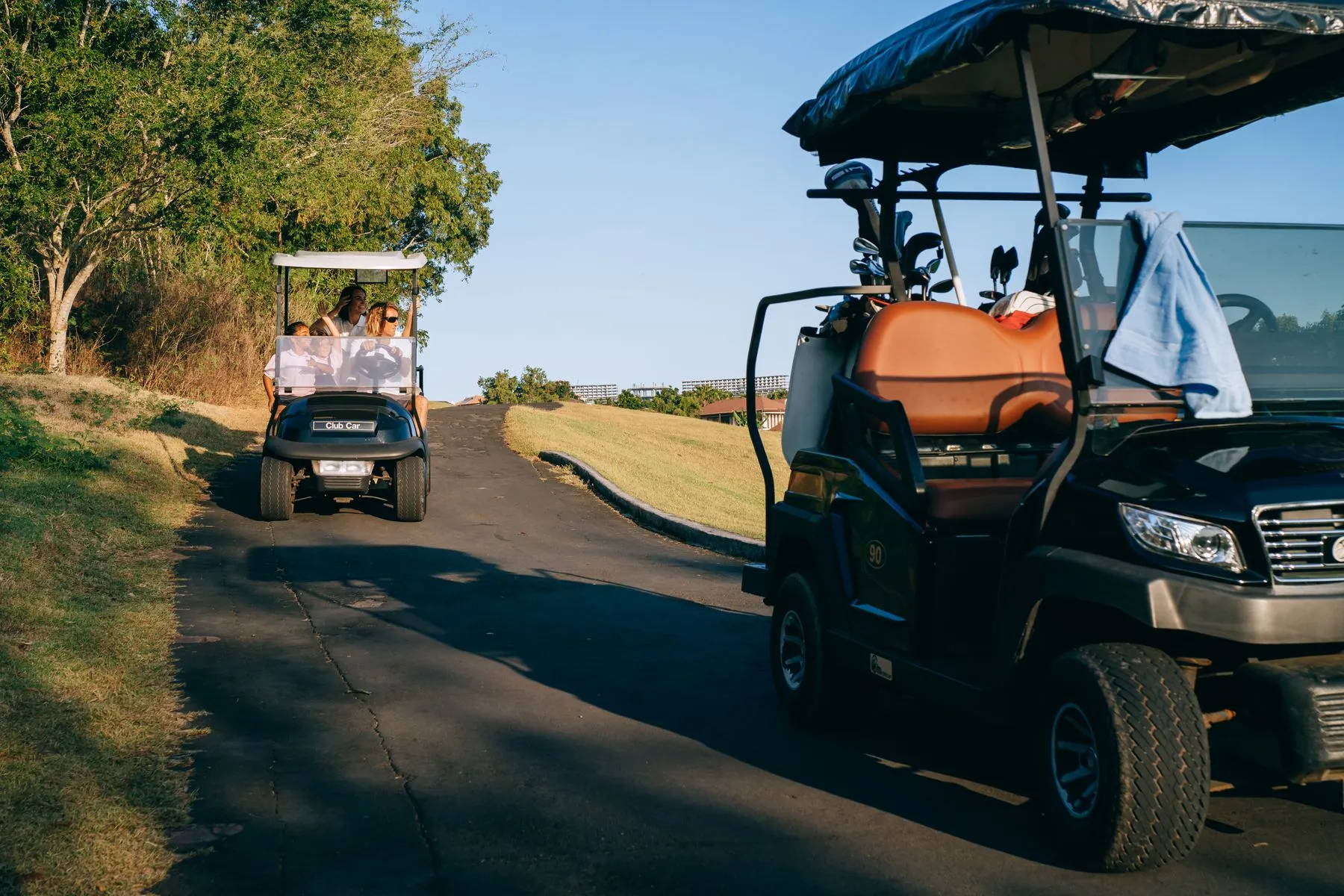
Best golf cart lift kits: spindle, A-arm and long-travel compared
A lift kit is three to six inches of height, a wider stance and room for 22 or 23 inch tires. These are the kits that fit cleanly on the common carts, from the cheap spindle lift that most owners should buy to the long-travel kit for a cart that sees trails.
Best picks · 6 picksUpdated Nov 5, 2026
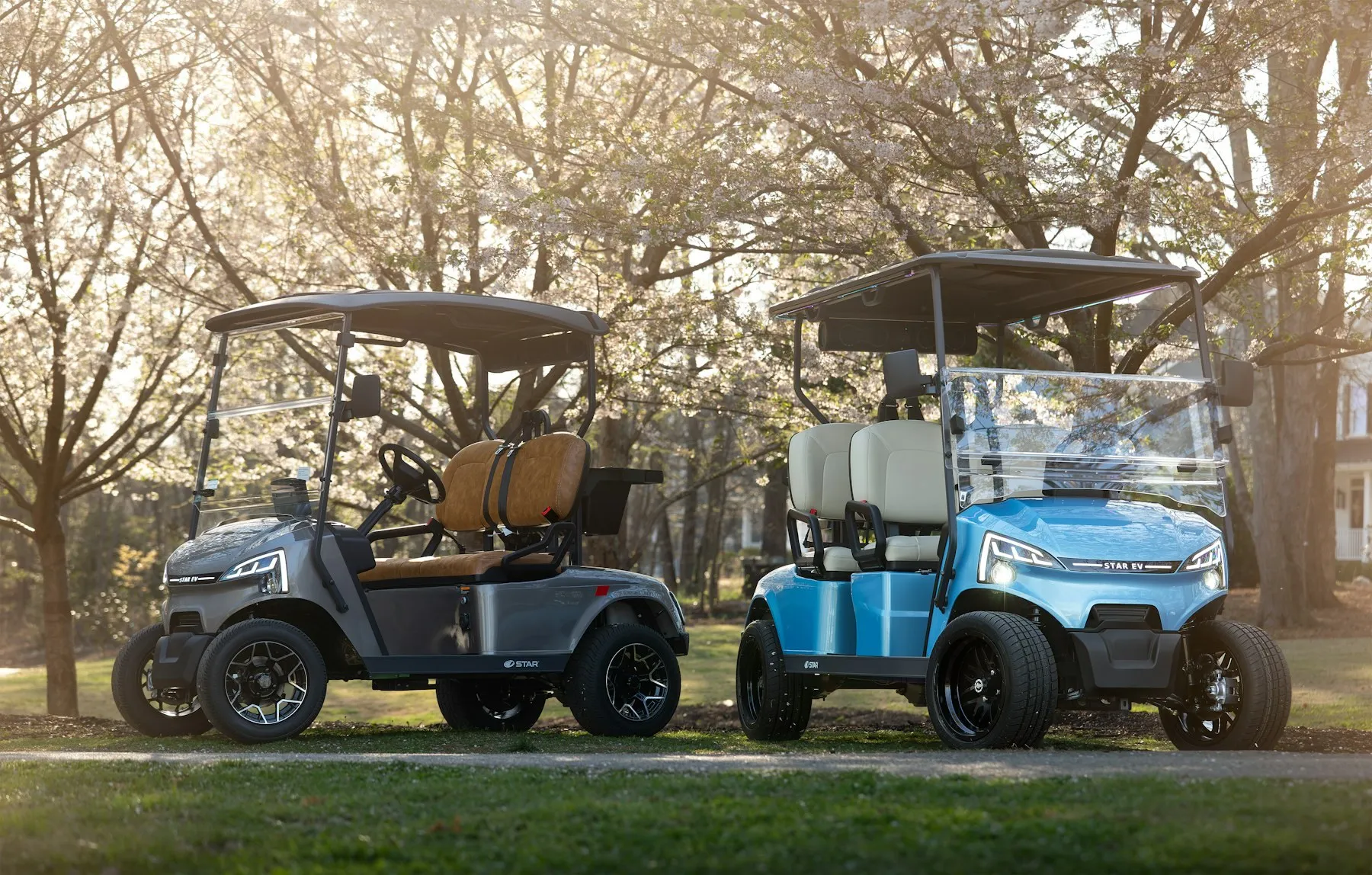
Best golf cart wheels: 10, 12 and 14 inch sets that fit without a lift
Every golf cart wheel from the big three makes shares the same 4x4 bolt pattern, so the question is never whether a wheel fits the hub. It is whether the tire on it clears the body. These are the wheel and combo sizes that do, with and without a lift.
Best picks · 6 picksUpdated Nov 5, 2026
Other categories




Get the fitment guide for your cart
One page with your cart's voltage, tire sizes, lift-kit family and the parts that fit it. We send it once, then a short note when a price or a part changes.
No spam, and we never sell your address. One-click unsubscribe.