Golf cart speakers and electronics
Every electronic add-on on a golf cart comes down to two questions: how it mounts to the roof struts and where it gets 12 volts on a cart that has none. Answer those and the choice of sound bar or solar panel is the easy part.
Updated Nov 5, 2026 Every pick names the carts it fits
Our top picks in audio
The first pick from each buying guide. Open the guide for the alternatives and the reasons.
- Best overall
ECOXGEAR SoundExtreme SE18
From our best golf cart sound bars guide
Fits: Any cart with two front roof struts: Club Car DS and Precedent, EZGO TXT and RXV, Yamaha G-series and Drive
about$400–$500Details - Best overall
ECO-WORTHY 48V golf cart solar kit
From our guide: Golf cart solar panels
Fits: Any 48V cart with a flat roof about 48 inches wide: Club Car DS (1995 on), Precedent, EZGO TXT48 and RXV, Yamaha G19, G22, Drive and Drive2
about$200–$320Details
Which guide do you need?
Find your situation, then follow the link.
- Sound barMusic on a cart that lives outside; one unit, one clamp per strut$130–$1,000Read guide
- Overhead speaker consoleA built-in look under the roof with storage and a radio face$150–$300Read guide
- Portable Bluetooth speaker with strut mountA speaker you take off the cart and into the house$80–$220Read guide
- Roof solar panel kitA trickle of charge on a cart parked in full sun; not a replacement for the charger$180–$480Read guide
Price ranges are estimates as of Oct 17, 2026.
How to choose
Golf cart speakers are the most bought electronic add-on and the one most often wired wrong, so this section starts with power and mounting before it gets to brands. The two pages here are the sound bar guide, which also covers overhead consoles and portable Bluetooth speakers, and the solar panel page, which is mostly about what a roof panel does not do.
The power question
A golf cart is 36V or 48V and has no 12V circuit unless a previous owner added one. Every wired accessory, from a sound bar to a USB port, wants 12V. You have three ways to get it.
Tap two batteries. The old way: run wires off two 6V batteries, or one 12V, in the pack. It works and it costs nothing, and it drains those batteries faster than the rest so the pack ages unevenly and dies early. Do not do it on a pack you paid for.
Fit a voltage reducer. A small sealed box that takes the full pack voltage down to a regulated 12V, about $30 to $70 for an import 30-amp unit or $85 to $115 for a Reliance from a golf cart parts shop. Thirty amps runs a sound bar, a light kit and a phone charger together. It wires to the main positive and negative, draws evenly from the whole pack, and is the right answer on any electric cart, lead-acid or lithium. The light kit guide covers the wiring.
Buy self-powered gear. Sound bars with an internal battery (ECOXGEAR and others) and portable Bluetooth speakers need no cart wiring; they charge from a wall outlet or a USB port and run for 8 to 20 hours. If the cart is lead-acid and you do not want to open the battery compartment, this is the path.
Gas carts are the exception: they have a 12V starting battery, and a wired sound bar runs off it through an inline fuse.
Mounting to the roof struts
Nearly everything covered here clamps to the two front roof struts or the cross bar under the roof. The struts are more alike than most listings suggest: Club Car DS and Precedent, EZGO RXV and later TXT, and Yamaha G-series, Drive and Drive2 all use square aluminum tube about 1 inch across, and the 1994 to 2013 TXT uses 3/4-inch square. Golf cart brackets, like ECOXGEAR’s, are made for that square strut. Side-by-side sound bars and many portable speaker mounts use clamps for round tubes, which do not grip a square strut as well, so measure the strut where the clamp lands and buy for it.
Overhead speaker consoles bolt to the underside of the roof between the struts and need a roof at least 54 inches wide, which rules out some older short tops. Dash-mounted radios are rare now; the console or the bar replaced them.
Fitment pages for Club Car, EZGO and Yamaha list the strut shape and voltage by model year.
Weather rating
A golf cart lives outside, gets hosed off, and rides through sprinklers. Buy audio rated IP66 or better: dust-tight and proof against powerful water jets. IP67 adds brief immersion. Anything rated IPX4, which is splash-proof, is a kitchen speaker and will fail by the second summer. Check that the charging port has a cap and that the clamps are stainless or coated steel, because the rust starts at the clamp.
Sound bars, consoles and portable speakers
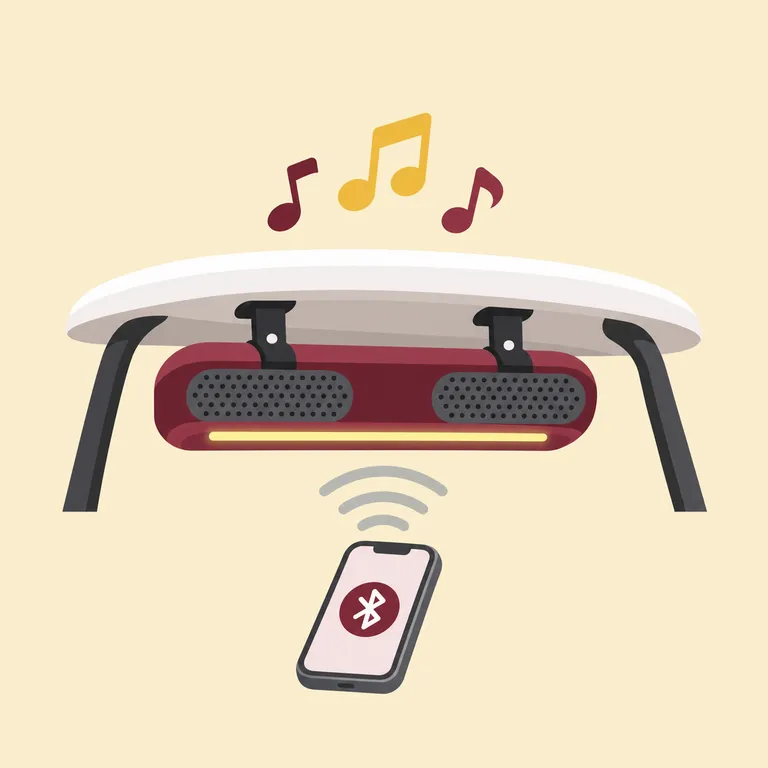
A sound bar is one sealed unit, 18 to 32 inches wide, with four to eight speakers, Bluetooth, and often LED lighting. Clamp it to the struts, pair your phone, done. Prices run about $130 for a basic bar to $1,000 for the marine-grade units. An overhead console is a molded tray that bolts under the roof with speakers at each end and a radio face in the middle; it looks built in and gives you a shelf, for about $150 to $300 plus the reducer. A portable Bluetooth speaker in a strut mount is the cheapest and the one you take off the cart; about $80 to $220 with the mount. The sound bar guide compares them by cart.
Solar: what a roof panel actually does
A 100-watt panel flat on a roof in full sun makes about 300 to 400 watt-hours on a good day, which at a typical cart’s 150 to 180 watt-hours per mile is a mile or two of range. It keeps a parked cart topped up and offsets a short daily trip. It does not replace the charger, and the controller must match your pack: a 36V or 48V controller, not the 12V units sold for RVs, and a lithium profile if the pack is lithium. The solar page has the arithmetic.
What fits each make
Club Car
DS, Precedent, Onward and Tempo roof struts are square aluminum tube about 1 inch across, the size most golf cart brackets and clamps are made for. All DS from 1995 and every Precedent are 48V; the DS to 1994 is 36V. None has a 12V tap, so a wired accessory needs a reducer. Gas carts have a 12V starting battery.
EZGO
TXT front struts are 3/4-inch square on 1994 to 2013 carts and about 1 inch from 2014; RXV struts are about 1-inch square. Check that a clamp closes down to 3/4 inch on an older TXT. TXT is 36V to 2009 and 48V from 2010; RXV is 48V. The Liberty is lithium with no accessible tap at all. On any electric EZGO use a reducer rather than tapping two batteries.
Yamaha
G-series, Drive and Drive2 struts are square tube about 1 inch across, the common golf cart size. G14 and G16 are 36V; G19, G22, Drive and Drive2 are 48V. Yamaha gas carts have a 12V battery that will run a sound bar directly through a fuse.
Questions owners ask
Can I run a 12V sound bar on a 48V golf cart?
Yes, through a voltage reducer that takes the full pack down to 12V, about $30 to $70 for an import 30-amp unit. Do not tap two batteries for 12V; it unbalances the pack and shortens its life.
Do I need a reducer for a Bluetooth speaker?
Not if it is self-powered. Sound bars with an internal battery and portable speakers charge from a wall or a USB port and need no cart wiring at all. Reducers are for wired units.
Will a sound bar fit my roof struts?
Almost certainly. Nearly every Club Car, EZGO and Yamaha strut is square tube about 1 inch across, and golf cart brackets are made for it. The exception is the 1994 to 2013 EZGO TXT at 3/4 inch, and bars made for side-by-sides often use round-tube clamps, so check the clamp range.
Does a solar panel charge a golf cart?
It adds a trickle, roughly a mile or two of range per sunny day from a 100-watt panel, and keeps a parked cart topped up. It does not replace the wall charger.
Every audio guide
Best picks (2)

Best golf cart sound bars: ECOXGEAR, Wet Sounds, MTX and budget
A sound bar clamps to the two front roof struts and pairs with your phone, and that is the whole install if you buy a self-powered one. The wired bars sound better and never need charging, but they need 12V, and a golf cart does not have any. Here is how to choose.
Best picks · 8 picksUpdated Nov 5, 2026
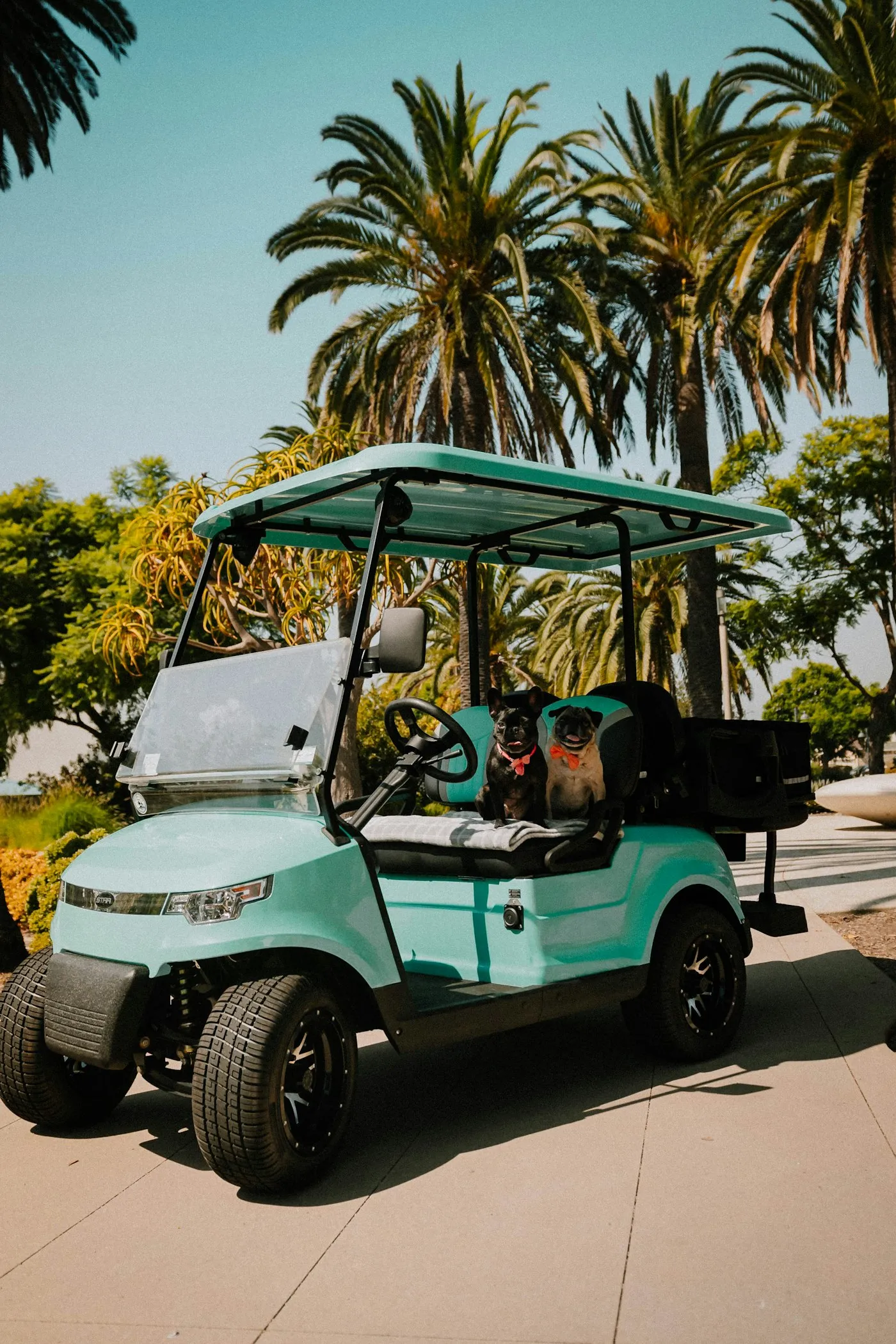
Golf cart solar panels: what a roof panel really adds
A 100-watt panel flat on a cart roof makes about 300 to 400 watt-hours on a good day, which is a mile or two of driving. It keeps a parked cart topped up and offsets a short daily trip. It is not a free charge, and the controller has to match your pack voltage and chemistry.
Best picks · 4 picksUpdated Nov 5, 2026
Other categories
Get the fitment guide for your cart
One page with your cart's voltage, tire sizes, lift-kit family and the parts that fit it. We send it once, then a short note when a price or a part changes.
No spam, and we never sell your address. One-click unsubscribe.